ClickMagick vs Google Analytics 4
The network confirmed the sale after the click, and Analytics had no URL waiting for that call.
Pick ClickMagick if you buy traffic for affiliate or network offers and need each click ID stored with the outcome the network posts back, before you send conversions to Meta or Google; pick Google Analytics if you only need free reporting for a site or app you own, with key events on pages you control.
The two products keep different books. Analytics records what a tagged site or app does while the visitor is still there. ClickMagick stores the click, then waits for the network to report what that click earned. If the network decides the commission, start here.
What Google Analytics 4 records
Google's Analytics page offers standard Google Analytics free of charge for web and app measurement, and it connects that property with Google Ads, Search Ads 360, and Display & Video 360. Analytics 360 is the enterprise edition on the same page. You buy it by talking to sales, and no public price is given.
The attribution article lists three models in the Advertising reports: data-driven attribution, paid and organic last click, and Google paid channels last click. Data-driven attribution uses machine learning on paths that converted and on paths that never converted, then assigns the credit. The same article says first click, linear, time decay, and position-based models left those reports in November 2023. Those three names are the models you can still select.
The features page says Analytics conversions and audiences can be imported into a Google Ads account, and that Ads campaign data shows in the Advertising workspace. The same page describes JavaScript libraries, mobile app SDKs, and an open measurement protocol for interaction data from any internet-connected system you connect. A key event you define on a page you control belongs here, and so does a purchase on your own checkout or a step inside an app you ship.
On a property that carries your tag, the events you marked and the linked Google Ads account are both available under that account. You feel the limit when the sale happens on a checkout you do not control.
Google Analytics vs an affiliate tracker
It comes down to who holds the click ID when the network fires its postback. The tracker logs that ID when the ad click happens, passes it to the offer, and waits for the network to return a status. Analytics is measuring the browser session on the property you tagged.
Affiliate buyers say Analytics counts fewer sales than the network's conversion report, because it follows the click. Those same reports describe affiliates staying on the free account while volume is low, then finding mismatches once spend rises and payouts depend on approved conversions. The missing sales are commissions that confirm on the network's checkout, after the visitor has left your domain, with a status the network assigns after the click.
The Measurement Protocol is a push you send, not a URL the network calls. You can import a hit from a system you run. The network returns the click ID and the commission status via the tracker's postback URL. To point the next ad dollar at commissions that actually pay, you need that tracker.
A checkout on your own domain is a separate case. If you already saved the gclid on the order, send the paid order back to Google with the gclid. A network checkout never gives you that order page. The gclid upload applies when you run the checkout. Meta has the same split between a thank-you page and a later approval, which is covered in Meta Conversions API through a tracker or Google Tag Manager.
What ClickMagick keeps for the network sale
ClickMagick's tracking page says the product is integrated with 100+ of the most popular affiliate networks, through server-to-server postback tracking. The affiliate network calls ClickMagick with a postback. The click ID that went out with the visitor comes back with the conversion.
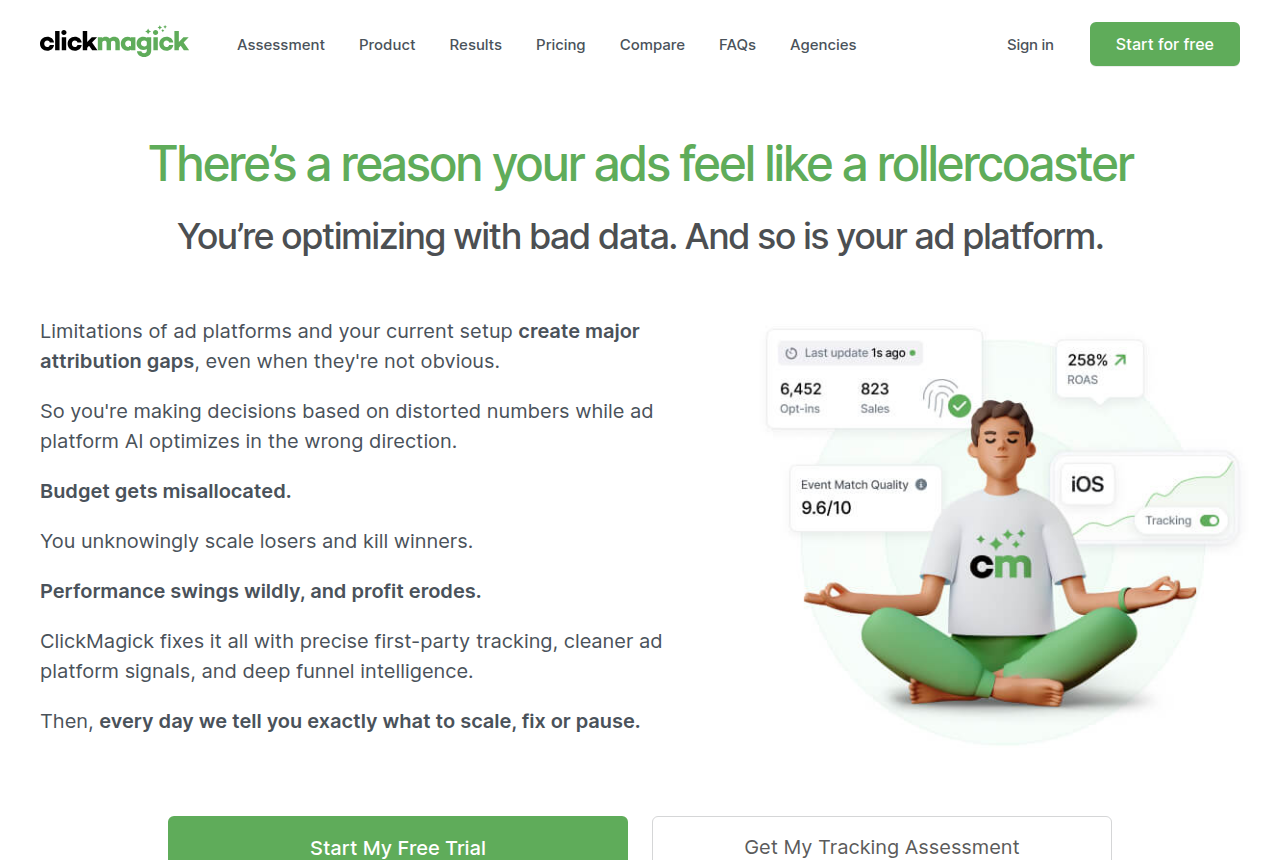
The homepage describes TrueTracking as the record of every click and every conversion on paid traffic, the place you check before you pass a result to an ad platform. ClickMagick's own comparison with Google Analytics 4 says it can send the Google click ID back to Google, along with the other fields Google uses to optimize. Audience Optimization, which the pricing page lists as CAPI, is on Starter, so the Meta upload is on that first paid tier as well.
Starter also includes 10,000 tracked visitors and one ad account on each platform. Affiliate campaigns with no cap are listed on Standard. Starter keeps the data for six months. Past that cap, the pricing page shows no per-visitor fee, and it never states that tracking stops. The ClickMagick review covers that entry plan. Signup terms are on the pricing write-up.
When that cap is the limit you will hit, read ClickMagick vs Voluum. When you want server-side uploads on a larger pool from the first bill, read RedTrack vs ClickMagick. If you still need to decide whether the page belongs in the same product as the postback, use the tracker or funnel platform picker.
Voluum vs Google Analytics
Comparing Voluum with Google Analytics shows the same gap inside an event-based tracker. Voluum's homepage says "Voluum filled the gaps that Google Analytics left wide open." It is sold as an ad tracker. Conversions are sent back to the ad platforms once the campaign is tracked in Voluum.
The homepage offers a 14-day platform preview and says no payment details are required. Profit, the plan for a buyer who has outgrown a visitor cap, is $119 a month when the year is paid up front. Event limits, the campaign cap, and any extra charge are on Voluum pricing. A buyer at that volume should read it, then the ClickMagick comparison linked above.
Standard Analytics stays the no-cost account for a site you own. Voluum is the paid tracker you add when the network status has to match a stored click ID, on a plan sized by events.
Quick answer
ClickMagick is our top pick for most people. ClickMagick works for a small account that wants CAPI and can stay within the visitor limit.
- ClickMagick. Best for an account with a visitor cap. From $79/mo.
- Google Analytics. Best for free reporting on a site you own. Has a free tier.
The entry plans side by side
The price column shows the starting monthly price. A blank cell means that product's feature list does not mention it.
| Tool | Listed price | Trial | Meter | Ads send | Affiliate | Revenue source | From |
|---|---|---|---|---|---|---|---|
| 3. ClickMagick | $79/mo | 14 days | 10,000 visitors | On Starter | Unlimited on Standard | Clicks and postbacks | $79/mo |
| Google Analytics | $0 | Free product | Site and app events | Key events to Google Ads | No network callback | Events you tag | Free tier |

ClickMagick
What works
- Starter includes Audience Optimization, which the pricing page lists as CAPI.
- The entry plan is the lowest of the three we priced, and the trial is 14 days.
- A first-party tracking domain is on the Starter feature list.
What to watch
- Starter includes 10,000 tracked visitors and one ad account per platform.
- Affiliate campaigns without a cap are listed on Standard. Starter keeps data for six months.
- The pricing page does not state what happens once you exceed the visitor allowance.
Google Analytics
What works
- Standard Analytics is free for web and app measurement.
- Conversions and audiences can be imported into Google Ads.
- Advertising reports include a data-driven model and two last-click models.
What to watch
- There is no postback URL where a network can report an approved, held, or rejected commission.
- The Measurement Protocol accepts interaction data you push from a system you connect.
- Data-driven attribution assigns credit with machine learning, including on paths that did not convert.
What you pay to start
Standard Google Analytics costs nothing. That offer is on Google's Analytics page, linked above. Analytics 360 requires a conversation with the sales team, and no public price is given.
ClickMagick Starter is $79 a month, or $66 a month when you pay for the year. Signup includes 14 days and the note "Don't pay today." The signup page does not say whether a card is collected. One ad account per platform is part of Starter, along with the cap named above. The yearly total and the refund window are on the pricing write-up linked in the ClickMagick section.
When the page, the checkout, and the network sale share a record
ClickMagick watches the click and the postback. Analytics watches the property. The landing page and the checkout are still separate tools.
ElasticFunnels is a funnel platform for teams that run paid traffic. Pages, same-URL split testing, checkout, a CRM, and attribution all share one data layer. The homepage says that for paid ads or affiliate traffic, "every session, order, rebill and refund sits on one timeline." Choose it when the network postback, the order, and the ad click should share one customer record.
Same-URL testing keeps the ad link stable while you try a new page. Variants rotate on the server under one campaign link, so Meta, Google, and TikTok keep the learning already attached to that link. The builder can generate a page from a prompt or clone one from a URL. Checkout charges through Stripe, NMI, PayPal, Klarna, or Authorize.net, and it can also send the buyer on to ClickBank, Shopify Checkout, or another external checkout. Order bumps, one-click upsells, and subscriptions are on the hosted checkout. Multi-MID routing works through NMI only. It splits the first sale by weight across the merchant's NMI accounts, with rules and a daily cap, and the upsell stays on the account that took the original sale. Stripe, PayPal, Klarna, and Authorize.net each connect as a single account.
Every feature is on every plan. Plans differ by page views, brands, domains, team seats, and automation runs. Starter is $97 a month, with 50,000 page views, or $937 billed for the year. The trial lasts 14 days and does not ask for a credit card. Pages, funnels, and a custom domain can be set up while it runs. A 0.5 percent fee applies to revenue processed through Stripe, NMI, PayPal, Klarna, or Authorize.net. Sales through an external checkout or a network are not charged that fee.
ElasticFunnels is newer than the platforms it competes with, and there is very little independent third-party review coverage to check its claims against. Until you run real volume through it, you are largely taking the vendor's word for how attribution behaves. It has been on the market since 2023, which is why so few independent reviews of the tracking exist yet. Pages, checkout, and the CRM still come with every plan, and independent reviews are still sparse.
Buyers who weigh funnel platforms look at ElasticFunnels vs ClickFunnels for pages and funnels, and at Konnektive when the comparison is checkout and MID routing. A team whose landers already live elsewhere still buys a tracker for the click and the postback. Plans above Starter are covered in the ElasticFunnels review.
Where I would start
I would choose ClickMagick when an offer pays through a network and the click ID has to be on file for the status that comes back. I would leave Google Analytics on any site or app I control, and I would mark the key events there. I would look at ElasticFunnels when the page and the checkout need to share that record with the network status.
Every other pair is on the head-to-head comparisons hub.
Our pick
ClickMagick
ClickMagick works for a small account that wants CAPI and can stay within the visitor limit.
Questions
Can Google Analytics 4 replace an affiliate tracker?
Does Analytics take a postback from an affiliate network?
Is Voluum the same product as Google Analytics?
When is the free Analytics account enough?
What we read
From ClickMagick
Google Analytics pages
From Google Analytics
Where to read the next piece
- Signup terms, the yearly price, and the refund window.
- ClickMagick review, the entry plan on its own page.
- Google Analytics review, the free account on its own page.
- ClickMagick vs Voluum, when the visitor cap is the constraint.
- RedTrack vs ClickMagick, for server-side uploads on a larger pool.
- Send the paid order back to Google with the gclid, when you run the checkout.
- Meta Conversions API through a tracker or Google Tag Manager.
- Tracker or funnel platform picker.
- ElasticFunnels vs ClickFunnels.
- Head-to-head comparisons hub.
Written by
Nadia Lindqvist
Affiliate tracking
Nadia covers affiliate tracking software for people who buy Meta and Google traffic. She reads vendor pricing pages, documentation and long-term user reports, and she writes about which tracker fits a given buyer.
Last checked 2026-10-21
Comments
No comments yet. Questions and your own experience are welcome.
Thank you. Your comment will appear once it has been reviewed.