BeMob vs Voluum
BeMob is a cloud tracker with a free event allowance. Voluum Profit is the million-event pool.
Pick BeMob if you will stay within the free 100,000-event cap, or if you want Professional's million-event plan and can work within Free's campaign, offer, and landing-page limits; pick Voluum if you need traffic distribution on Profit, cost syncing within its ad-spend allowance, or impression-heavy traffic where ten impressions count as one billable event.
You are down to these two. BeMob is a cloud affiliate tracker, and new accounts start with a free event allowance. Voluum Profit is the paid plan, with a shared event pool.
What the BeMob tracker counts as an event
BeMob's pricing page defines an event as every impression, visit, click, and conversion. Each of those actions draws one unit from the quota.
An impression is the ad view, a visit is the lander load, a click is the hop toward the offer, and a conversion is the network's later postback. BeMob counts each of the four as one event.
Voluum's documentation on events batches impressions together. Ten impressions count as one billable event. A visit, a click, and a conversion each count as one, and all four kinds share one pool.
Run the same campaign with impression tracking on and BeMob spends an event on every view while Voluum spends an event on every tenth view. The visit, the click, and the conversion still cost one event on both meters. If you are also weighing ClickMagick's visitor cap, read ClickMagick versus Voluum on visitors against Profit's event pool.
Free's hard stop against a 14-day preview
BeMob's subscription docs say the plan you get at registration is Free. It includes 100,000 events per 30-day billing period, one month of data retention, and a limited set of features. You can try BeMob by signing up, which starts you on the Free plan. The allowance resets every 30 days. That billing window is the one named in those docs.
The pricing-structure page says Free does not support event overage. Once the included limit is reached, tracking stops. Leave the subscription on Free after that and the account will be blocked.
The pricing table lists Free at 10 campaigns, 10 offers, and 5 landing pages. Those caps sit beside the event meter. A short campaign list can hit the campaign limit while events remain, and a busy impression pixel can empty the event meter while the campaign count still has room.
Voluum's homepage offers a platform preview for 14 days and says no payment details are required. Profit is the entry-level paid plan. Voluum includes up to 1,000,000 events on that plan.
The paid rows that each include a million events
Professional is BeMob's paid plan. It includes 1,000,000 events in the billing period, at the monthly rate in the table. Events past that allowance are charged at $0.05 per 1,000 at the end of the cycle.
Profit is listed at $119 a month billed annually, with 20 active campaigns beside the event pool. Overage above the included events is $0.06 per 1,000. That figure is the annual rate.
The headline pool matches on the two paid rows. The impression rule and Profit's live-campaign cap are what still separate them. If that campaign cap is your limit, see RedTrack versus Voluum. Solo leaves the campaign count open.
What Profit adds on top of the pool
Traffic Distribution AI is included on Profit. Voluum describes it as automatic optimization of campaign performance.
Auto-rules and API integrations stay free up to $1,000 of ad spend a month, and that line includes 10 auto-rules. Spend above the allowance moves onto an Automizer subscription. The event pool and the spend allowance are separate meters. A quiet account can still owe that subscription once ad spend crosses the line, and a heavy event month can owe overage while spend stays inside the allowance. The Voluum review covers Profit on its own. See the Voluum alternatives if the campaign cap is why you would switch. The quota and the cap together are on the Voluum pricing breakdown.
BeMob vs ClickMagick
ClickMagick Starter includes 10,000 tracked visitors and one ad account per platform. BeMob's free allowance is an event pool, and registration is what opens it. A visitor total that still fits Starter can already be costly on BeMob once every impression is its own event.
The ClickMagick review covers the visitor plan on its own. RedTrack versus ClickMagick lines up the two entry-level paid prices.
Quick answer
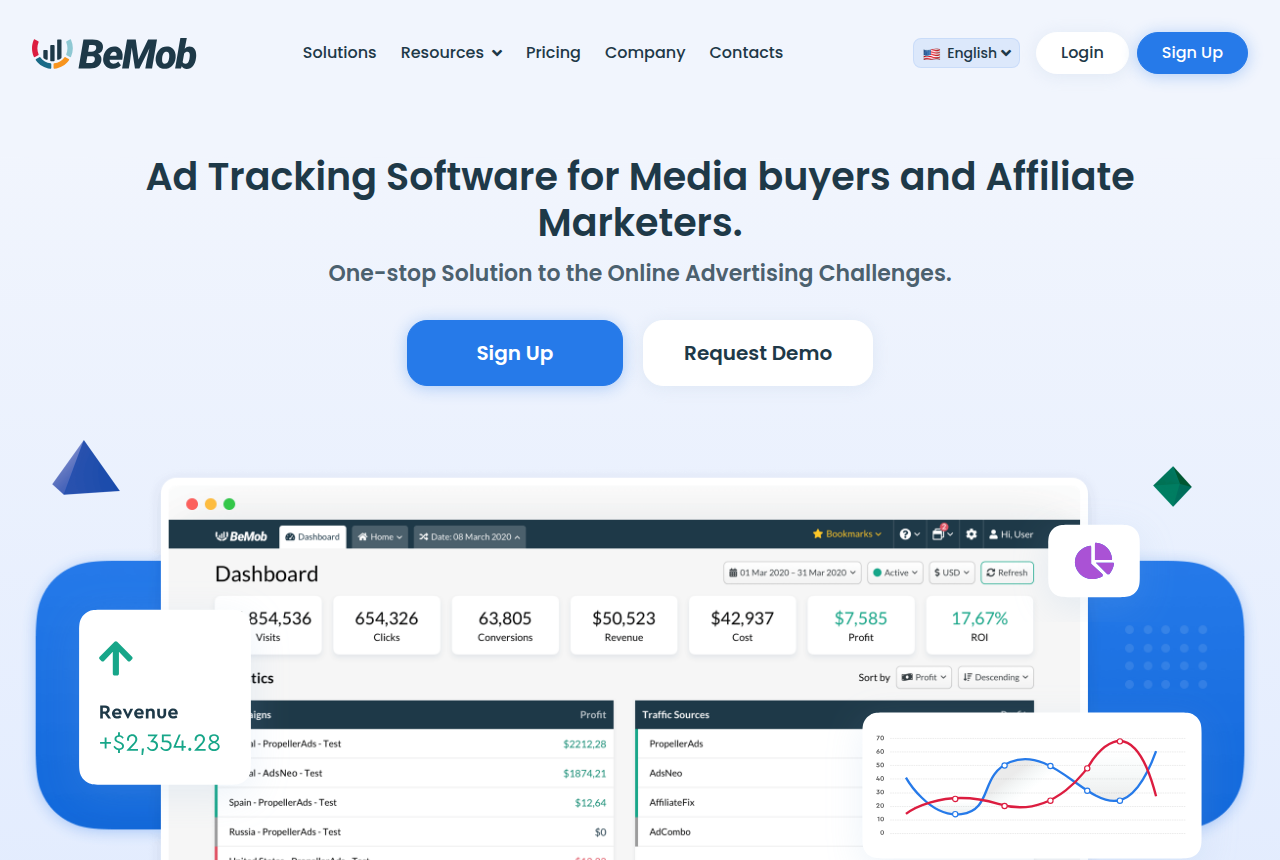
BeMob is our top pick for most people. BeMob works well if your traffic stays within the free event allowance or Professional's event limit, and if 10 campaigns, 10 offers, and 5 landing pages are enough on the Free plan.
- BeMob. Best for a free event allowance. Has a free tier.
- Voluum. Best for a million events. From $119/mo.
The entry plans side by side
The price column shows the starting monthly price. A blank cell means that product's feature list does not mention it.
| Tool | Paid entry | Event pool | Overage | Campaigns | How you start | Traffic AI | From |
|---|---|---|---|---|---|---|---|
| BeMob | $49/mo | 100,000 on Free | $0.05 / 1,000 | 10 on Free | Free plan | –Unknown | Free tier |
| 4. Voluum | $119/mo annual | 1 million events | $0.06 / 1,000 | 20 | 14 days, no card | On Profit | $119/mo |
BeMob
What works
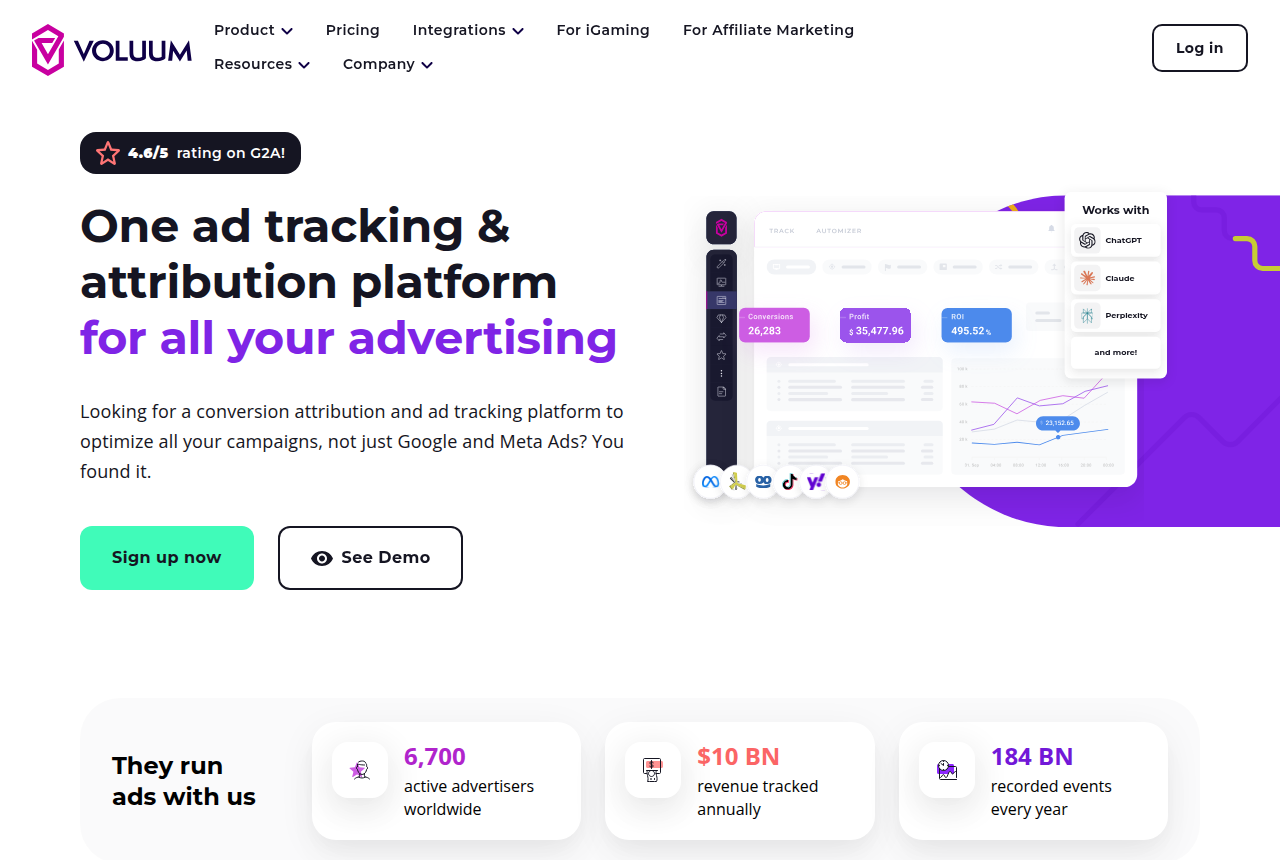
- Signing up puts you on the Free plan, which includes one month of data retention.
- Professional includes a million events at the monthly rate in the comparison table.
- Events past the Professional allowance are billed per thousand at the end of the cycle.
What to watch
- You cannot buy extra events on the Free plan. Tracking stops at the included limit, and the account can be blocked if you stay on that plan.
- Free caps active use at 10 campaigns, 10 offers, and 5 landing pages.
- Each impression counts as one event, so an impression pixel spends the allowance faster than a meter that groups impressions.
Voluum
What works
- Profit includes up to 1,000,000 events.
- Traffic Distribution AI is on the Profit feature list.
- The homepage offers a 14-day platform preview and says no payment details are required.
What to watch
- Profit includes 20 active campaigns.
- Auto-rules and API integrations are free only up to $1,000 of ad spend a month, then Automizer is a separate subscription.
- Public reviews describe the setup as more complex than a visitor-capped tracker, and say the price pays off once ad spend is high enough to use the allowance.
What you pay once you reach the limit
The table above compares the paid price, the event allowance, the overage rate, the campaign limit, and the way you start. Professional bills extra events at the end of the cycle. Free cuts tracking off instead.
On Free, extra events are not for sale. Tracking stops at the included limit, and the account can be blocked if the subscription stays there. Professional keeps tracking on and bills you for the extra events.
When the live-campaign cap or the included pool is the limit you will outgrow, Scale is the next annual Voluum plan. The Voluum pricing breakdown puts Scale next to Profit.
When the page, the checkout, and the postback share one record
BeMob and Voluum are trackers. They sit beside a lander that already lives somewhere else. ElasticFunnels is a funnel platform for teams that run paid traffic. The page, a same-URL split test, the checkout, and the attribution sit on one data layer, so a network can post the sale back onto that same record.
Same-URL split testing is the piece that lines up with an ad account. Variants rotate on the server under one campaign link, so Meta, Google, and TikTok keep the learning on that link. The platform also builds pages, from a prompt or by cloning a URL, and it hosts the checkout, with order bumps, one-click upsells, and subscriptions. Every feature is on every plan. Plans differ by usage limits.
Starter is $97 a month, or $937 billed for the year, with 50,000 page views. A page view is one load of a page ElasticFunnels hosts. Bot, datacenter, and test traffic is left off the bill. The trial lasts 14 days, with no card required, and pages, funnels, and a custom domain can be set up during that trial. Checkout through Stripe, NMI, PayPal, Klarna, or Authorize.net carries a 0.5% fee on that revenue. Sales sent out to an external checkout or a network are not charged the fee.
ElasticFunnels is newer than the platforms it competes with, and there is very little independent review coverage to check its claims against. Until you run real volume through it, you are largely taking the vendor's word for how postbacks and conversion tracking behave. The platform launched in 2023, so it has had less time to collect independent reviews. You still get the pages, the checkout, and the CRM on the plan, even while independent reviews stay scarce. Anyone who already hosts the page and the checkout somewhere else, and only needs a tracker, should choose BeMob or Voluum. The hosted-page comparison is ElasticFunnels vs ClickFunnels, and the plan limits are on the ElasticFunnels pricing page.
Our pick
BeMob
BeMob works well if your traffic stays within the free event allowance or Professional's event limit, and if 10 campaigns, 10 offers, and 5 landing pages are enough on the Free plan.
Questions
What happens after the free BeMob allowance is used up?
How are impressions billed on Voluum?
Can you pay for events past the free cap?
How do Professional and Profit differ once both include a large pool?
Is the BeMob tracker a cloud product?
What we read
From BeMob
Voluum pages
From Voluum
Where to read the plan in full
- Facebook pixel vs Conversions API, which machine sends the Meta event.
- BeMob review for the free allowance on its own page.
- Voluum review for Profit on its own page.
- Voluum pricing breakdown for the quota beside the campaign cap.
- ClickMagick review for the visitor-capped plan.
- ClickMagick vs Voluum, visitors against Profit's event pool.
- RedTrack vs Voluum, when campaigns are uncapped on Solo.
- RedTrack vs ClickMagick, the two entry-level paid prices.
- Voluum alternatives if the campaign cap is why you would leave.
- BeMob alternatives if the free cap is why you would leave.
- Best affiliate trackers if you are not down to two.
- Purchase gap calculator for Ads Manager purchases against network-approved sales.
- All head-to-heads.
- How we research tracker pricing.
Written by
Nadia Lindqvist
Affiliate tracking
Nadia covers affiliate tracking software for people who buy Meta and Google traffic. She reads vendor pricing pages, documentation and long-term user reports, and she writes about which tracker fits a given buyer.
Last checked 2026-10-18
Comments
No comments yet. Questions and your own experience are welcome.
Thank you. Your comment will appear once it has been reviewed.