FunnelFlux vs Voluum
A drawn funnel on one side, Profit's campaign grid on the other.
Pick FunnelFlux if you draw multi-step funnels as connected nodes and your month still fits a 2 million-event pool; pick Voluum if you want Traffic Distribution AI and cost sync on Profit and can stay within 20 active campaigns and a 1 million-event pool, where ten impressions count as one event.
The other trackers are already off the list. What is left is a map of the path, or a campaign grid with distribution rules and one shared allowance.
A drawn funnel against a campaign grid
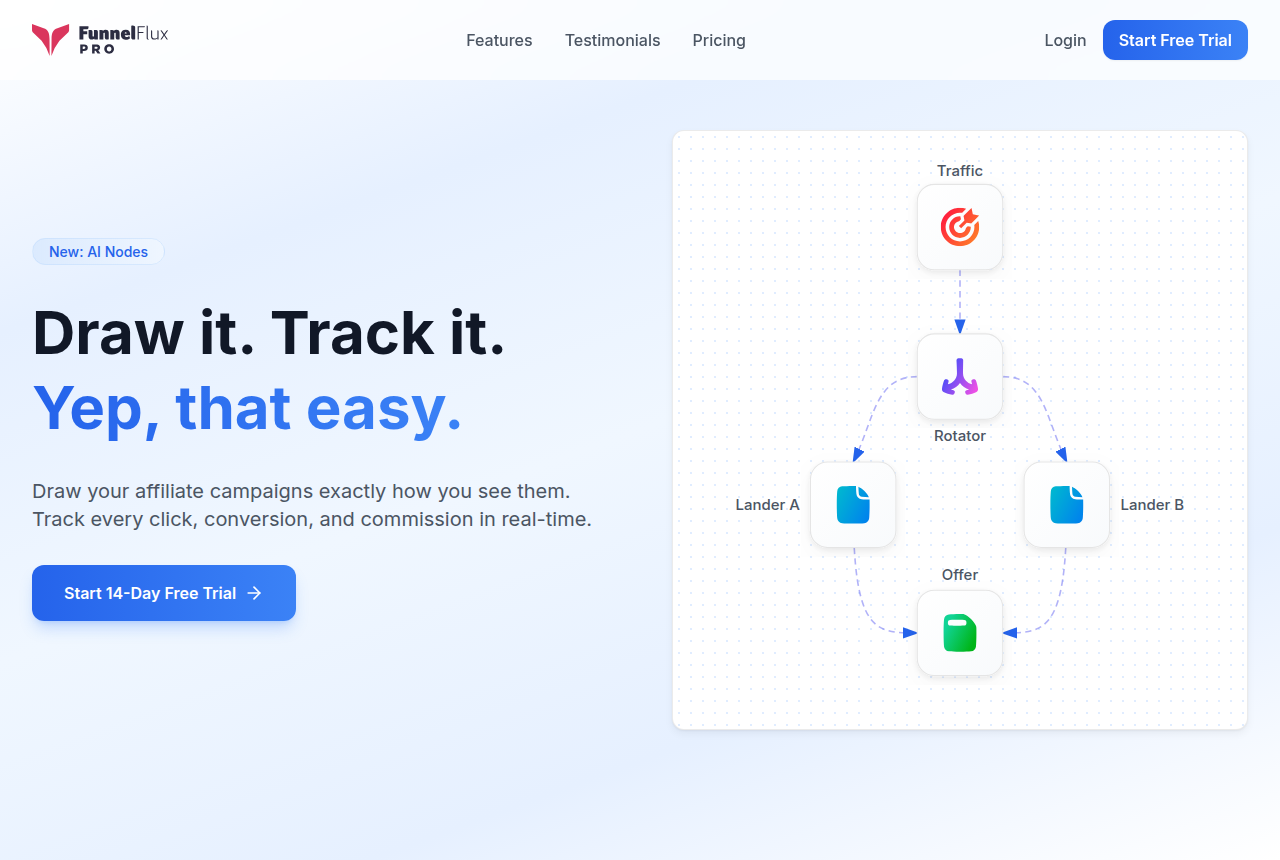
The FunnelFlux homepage sells a visual journey builder. Funnels are drawn as connected nodes. The diagram on that page runs from a traffic node, through a rotator, out to two landers, and into one offer.
Reporting follows those nodes. A rotator that splits clicks across two landers keeps each lander's clicks on its own branch, and the offer sits at the end of both branches. The commission posts back onto that path, so a lander's clicks stay with the branch that sent them.
A condition, a rotator, a lander and an offer are separate stops. A buyer who already sketches the path that way is the buyer this homepage is written for.
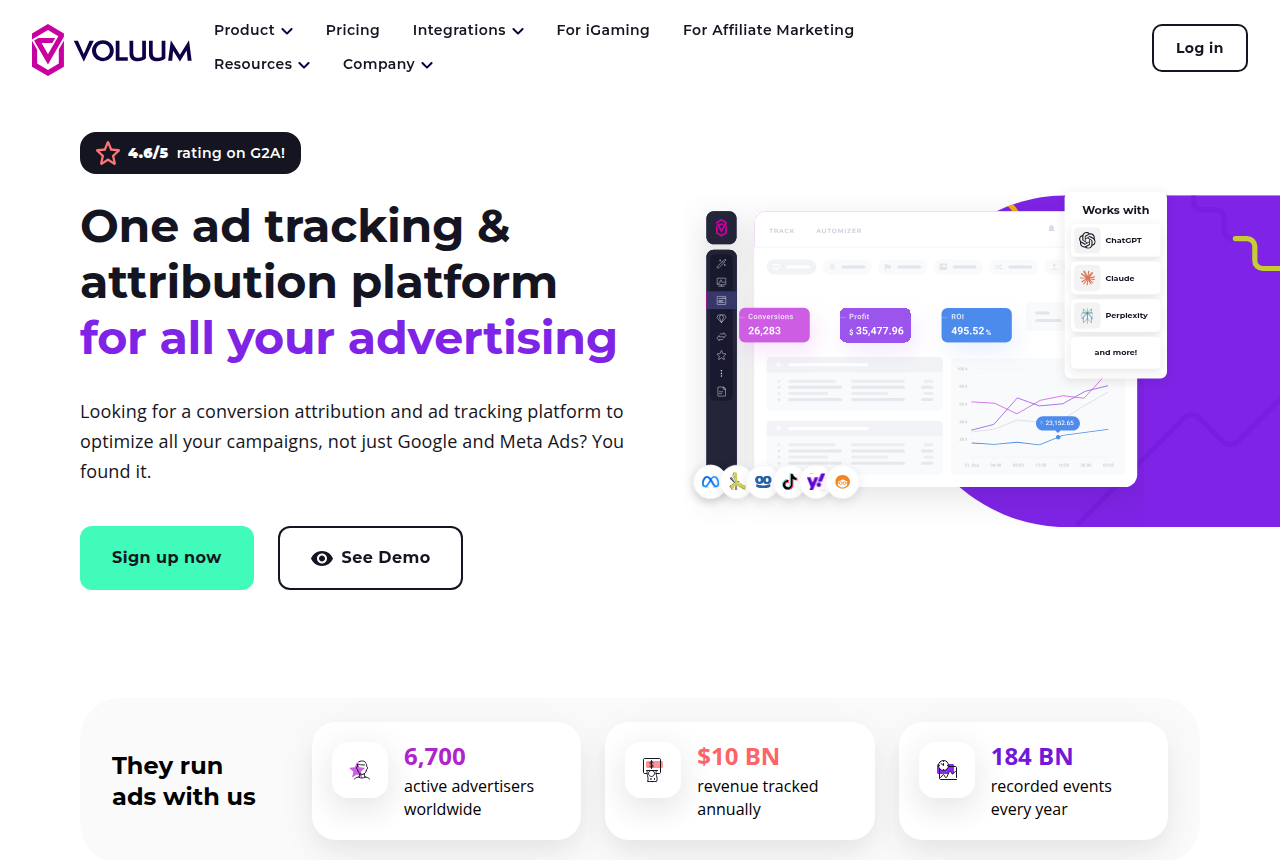
Voluum Profit is the other shape. Campaigns, landing pages and offers are rows, and Traffic Distribution AI sits on the Profit feature list. The same card includes the Anti-Fraud Kit. If the job is letting rules move traffic, and catching junk clicks in the same login, that card names both.
What each product counts
The homepage says FunnelFlux events cover tracking requests and internal events that create or store data. The list is visits, clicks, condition and rotator node visits, conversions, and custom events. A click that also touches a condition node and a rotator node has recorded those node visits as well as the click, before any conversion is posted.
A straight path from the ad to one lander to the offer records the click and, if it converts, the conversion. A map with several rotators records a node visit at each of those stops. The busier the drawing, the more of the allowance one visitor can use. A custom event on that same list spends the allowance too.
Voluum's event article puts impressions, visits, clicks, and conversions in one monthly pool. Ten impressions count as one billable event. A visit, a click, and a conversion each count as one event on their own, and each kind draws from that same pool.
An impression is the ad being shown. A visit is the landing page loading. A click is the hop from that page toward the offer. A conversion is the network posting the sale back. Turn impression tracking on and the Profit allowance moves faster than a click-only setup, because those impressions share the pool with the visits and the postbacks.
The two allowances differ in size, and each one uses its own list. A node visit and a batch of impressions are separate things. Match the invoice to the path you run: node visits on one side, impression batches on the other.
Other meters on this site use a different unit again. ClickMagick vs Voluum sets a visitor cap beside Profit. BeMob vs Voluum compares a free event cap with the same Profit card. Binom vs Voluum is the flat license when a monthly allowance is the problem. RedTrack vs Voluum is the pair when you want the campaign count left open.
Cost sync sits on different invoices
On Profit, auto-rules and API integrations stay free up to $1,000 of ad spend a month. Voluum's pricing page also lists a 1% overage above Automizer tier limits. Past that included band, Automizer is an extra subscription. A quiet month of clicks can still need that subscription once ad spend has left the free band. A heavy event month can add an event overage even while ad spend stays inside the band. The event overage and the Automizer subscription are billed apart from each other.
Cost sync with traffic sources is the Argosync subscription. It sits outside the FunnelFlux base plan. If you need ad spend in the tracker from the first month, on the same bill as the events, Profit includes that band.
The trial and the campaign ceiling
FunnelFlux requires a valid payment method before the trial starts. Voluum's homepage says the preview needs no payment details.
Profit also caps active landing pages at 10. A buyer running more live campaigns than the campaign cap cannot keep all of them on Profit. The FunnelFlux price block names the event allowance, the domain fees, and the trial. It does not list a campaign limit. The map and the event allowance are the restrictions the homepage states.
Where the conversion is sent
FunnelFlux passes conversion data server-side to TikTok, Facebook, Microsoft, and Google Ads. The network postback still has to land in the tracker before that handoff. If the open question is which machine should send the Meta event, read Facebook pixel vs Conversions API. The click id and the payout token are assembled in the postback URL builder.
Quick answer
FunnelFlux is our top pick for most people. FunnelFlux fits if you map funnels as a diagram of nodes and monthly volume stays within the published event allowance.
- FunnelFlux. Best for a drawn funnel map. From $99/mo.
- Voluum. Best for a million events. From $119/mo.
The entry plans side by side
The price column shows the starting monthly price. A blank cell means that product's feature list does not mention it.
| Tool | Entry price | Included events | Overage | Trial | Cost sync | Server signal | From |
|---|---|---|---|---|---|---|---|
| FunnelFlux | $99/mo | 2 million events | $10 per million | 14 days, card required | Argosync add-on | S2S to four ad platforms | $99/mo |
| 4. Voluum | $119/mo annual | 1 million events | $0.06 / 1,000 | 14 days, no card | Automizer to $1,000 | Signals back to ad platforms | $119/mo |
FunnelFlux
What works
- Funnels are drawn as connected nodes, so a condition or a rotator is part of the map.
- Conversion data can go server-side to TikTok, Facebook, Microsoft, and Google Ads.
- Extra events are billed per million on top of the monthly plan.
What to watch
- A valid payment method is required before the trial starts.
- Cost sync is Argosync, a separate subscription, outside the base plan.
- Condition and rotator node visits count as events, so a busy map spends the allowance faster than a straight click path.
- Public threads mention it less often than Voluum, so fewer long-running accounts are written up.
Voluum
What works
- Profit includes up to 1,000,000 events.
- Traffic Distribution AI is on the Profit feature list.
- The homepage offers a 14-day platform preview and says no payment details are required.
What to watch
- Profit includes 20 active campaigns.
- Auto-rules and API integrations are free only up to $1,000 of ad spend a month, then Automizer is a separate subscription.
- Public reviews describe the setup as more complex than a visitor-capped tracker, and say the price pays off once ad spend is high enough to use the allowance.
What each card charges
The homepage prices the FunnelFlux base plan at $99 a month, including 2 million events. Additional events are $10 per million. The first two custom domains are included. Each domain after those two is $2 a month.
Voluum's pricing page lists Profit at $119 a month when the year is billed up front. Events over the Profit allowance cost $0.06 per 1,000, which works out to $60 per million events. The $10 figure follows FunnelFlux's list, including node visits. The $60 figure follows Voluum's list, including impression batches. Each rate follows its own event list.
When the page, the checkout, and the postback share one record
FunnelFlux and Voluum record the click and the network's later postback. The landing page still lives somewhere else. ElasticFunnels is a funnel platform for teams that run paid traffic. A same-URL split test, the checkout, and the attribution sit on one data layer, so a network can post the sale back onto that record.
Same-URL split testing is the part that matters when the ad link has to stay put. Variants rotate on the server under one campaign link, so Meta, Google, and TikTok keep the learning on that link. The platform also builds pages from a prompt or by cloning a URL, and it hosts a checkout with order bumps, one-click upsells, and subscriptions. Every feature is on every plan, and the plans differ by page views, brands, domains, seats, and automation runs.
Starter is $97 a month, or $937 billed for the year, with 50,000 page views. A page view is one load of a page ElasticFunnels hosts. Bot traffic, data-center traffic, and test traffic do not count. The trial lasts 14 days and no credit card is required to start it. Pages, funnels, and a custom domain can be set up during the trial. A 0.5% checkout fee applies to revenue processed through Stripe, NMI, PayPal, Klarna, or Authorize.net. Sales sent through an external checkout or a network sit outside that fee.
ElasticFunnels is newer than the platforms it competes with, and there is very little independent review coverage to check its claims against. Until you run real volume through it, you are largely taking the vendor's word for how postbacks behave. ElasticFunnels has been on sale since 2023, so those independent reviews have had less time to accumulate. The pages, the checkout, and the customer record are still on the plan. The ElasticFunnels review covers the platform. ElasticFunnels vs ClickFunnels is the hosted-page comparison.
When Voluum is the better fit
I would choose Voluum when I need the distribution rules, the Anti-Fraud Kit, or impression traffic under Voluum's impression rule, and the account can stay within the campaign ceiling. FunnelFlux is the better buy when you need a visual funnel map, your month fits the base allowance, and you can pay for cost sync as a separate subscription.
Profit on its own is in the Voluum review. If the campaign cap is why you would switch, open Voluum alternatives. The entry plan picker compares the allowances if you are still looking at other trackers too.
Our pick
FunnelFlux
FunnelFlux fits if you map funnels as a diagram of nodes and monthly volume stays within the published event allowance.
Questions
How do FunnelFlux and Voluum count an event?
Does the FunnelFlux trial need a card?
How many campaigns can run on Voluum Profit?
Where does cost sync live?
What happens to the data if you cancel?
What we read
From FunnelFlux
Voluum pages
From Voluum
Where to read the plan in full
- FunnelFlux review, the base plan on its own page.
- FunnelFlux pricing, the allowance and the trial.
- FunnelFlux alternatives, if the map is why you would leave.
- Voluum pricing, the Profit quota and the campaign ceiling.
- All tracker reviews.
- All head-to-heads.
- How we research tracker pricing.
Written by
Nadia Lindqvist
Affiliate tracking
Nadia covers affiliate tracking software for people who buy Meta and Google traffic. She reads vendor pricing pages, documentation and long-term user reports, and she writes about which tracker fits a given buyer.
Last checked 2026-10-19
Comments
No comments yet. Questions and your own experience are welcome.
Thank you. Your comment will appear once it has been reviewed.