RedTrack vs Voluum
You are down to two event trackers, and each one bills a different set of actions.
Pick RedTrack if you need the Meta and Google conversion API and ad-level spend sync on Solo while running more than twenty live campaigns or five million click-and-conversion events; pick Voluum if Traffic Distribution AI on Profit matters and your live campaigns, landing pages, and event mix stay inside Profit's caps.
You are down to these two, and both of them bill by the event. The invoice changes based on which actions count, how many campaigns you can keep active, and whether Conversion API and cost sync are already included.
See which entry plan fits your traffic
Clicks and conversions, or a shared pool
RedTrack's pricing page says an event on Solo is a click or a conversion. That plan includes 5 million of them a month. Impressions and lander visits sit outside that definition, so a campaign that shows a lot of ads and gets few clicks spends the allowance slowly.
Voluum's documentation on events says usage comes out of a shared pool. Ten impressions count as one event. A visit counts as one, a click counts as one, and a conversion counts as one, and each type draws from the quota equally. One person who is shown an ad, lands, clicks the offer, and converts can use several events before anyone is paid. Profit includes up to 1,000,000 events in a billing period, so a mix heavy on impressions and lander visits can use up that pool while Solo is still only counting clicks and conversions.
Count a month of traffic in both units before you treat the lower annual rate as the cheaper plan. Both products bill clicks and conversions. Voluum also bills each visit, and it bills one event for every ten impressions. When that wider mix exhausts Profit's pool and Solo's allowance still has room, the smaller pool is the constraint. When clicks and conversions are what run out, Solo's allowance is the constraint, and the overage rates are in the next section.
The campaign limit is separate from either pool. Voluum's pricing page lists 20 active campaigns on Profit. RedTrack's card says campaigns, landers, and offers carry no artificial limits. A buyer running many angles at once will hit that cap while both pools still have room. The Voluum review covers Profit on its own. If that cap is the reason to switch, start with the Voluum alternatives. For a visitor count set next to this event pool, read ClickMagick vs Voluum. If ClickMagick is still in the set, read RedTrack vs ClickMagick on the first invoice.
Conversion API on the plan you choose
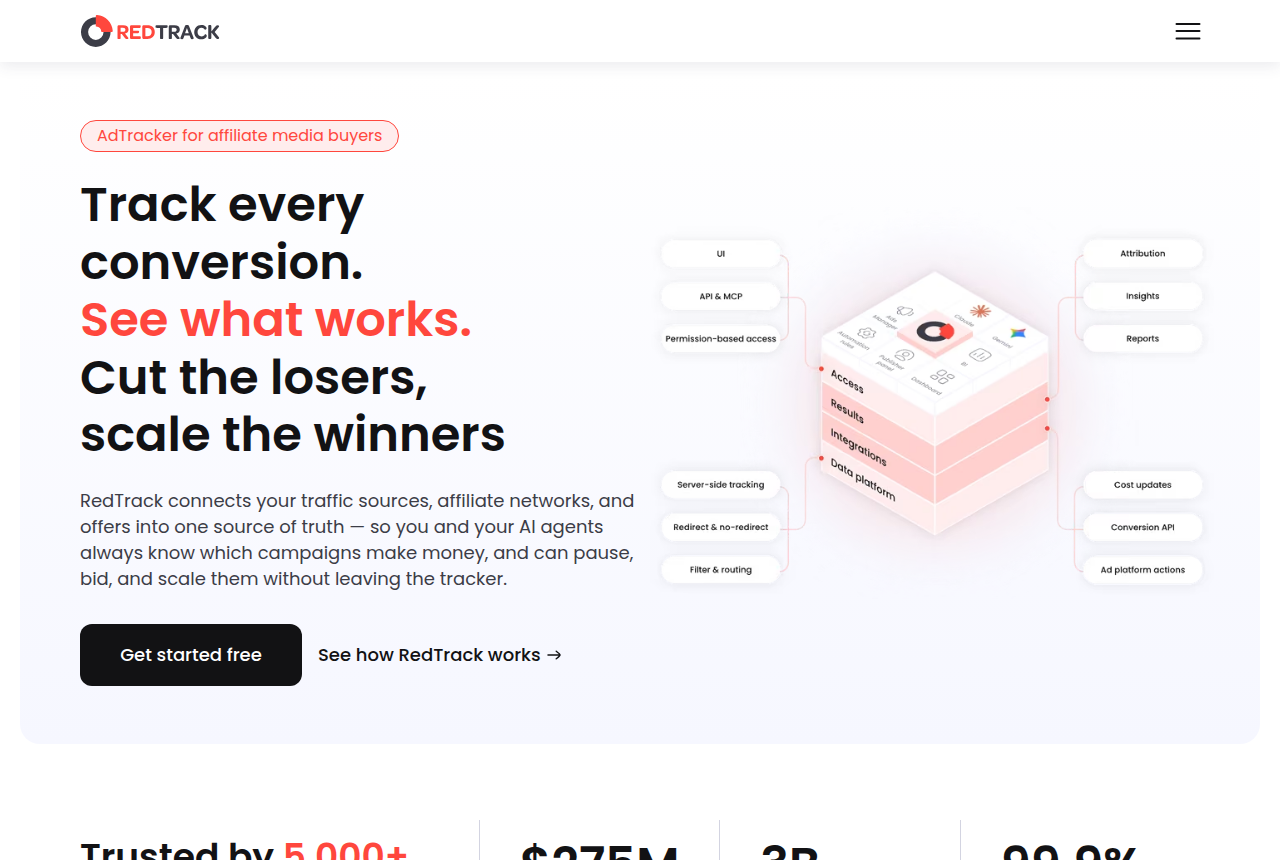
The same RedTrack card puts Conversion API, ad spend sync, and Stop Rules on every affiliate plan, and it states there is no ad spend limit. Solo refreshes cost from Meta, Google, and TikTok at the ad level every 60 minutes. Connected accounts are five per platform: five Meta and five Google, not five in total. The longer write-up is the RedTrack review. If one login is the limit you cannot live with, see the RedTrack alternatives.
Voluum's Facebook conversion integration takes a Pixel ID and a Conversion API token. That page tells you to turn off the Pixel Redirect URL once the postback is on, or the sale is reported twice. Cost sync is a different line on the Profit card: auto-rules and API integrations are free up to $1,000 of ad spend a month. Above that figure, Automizer is sold as its own subscription. The Automizer documentation says spend past the tier you subscribed to is charged at 1% of the additional ad spend.
Traffic Distribution AI is on Profit's feature list. Solo lists Conversion API, cost sync, and Stop Rules at that tier. If you still need to decide which machine sends the Meta event, read Facebook pixel vs Conversions API. Buyers who compare the two trackers in public tend to call RedTrack the easier start and Voluum the heavier setup once spend is large enough to need the paid Automizer tiers.
Quick answer
RedTrack is our top pick for most people. RedTrack is the one to choose if you want the Meta and Google conversion API, and ad spend sync, on the first affiliate plan.
- RedTrack. Best for included CAPI. From $141/mo.
- Voluum. Best for a million events. From $119/mo.
The entry plans side by side
The price column shows the starting monthly price. A blank cell means that product's feature list does not mention it.
| Tool | Solo events | Profit events | What counts | Campaigns | Live campaigns | CAPI | Automizer | Solo overage | Profit overage | Ad accounts | Traffic AI | From |
|---|---|---|---|---|---|---|---|---|---|---|---|---|
| 2. RedTrack | 5 million events per month on Solo | –Unknown | An event is a click or a conversion | Unlimited campaigns, landers and offers | –Unknown | On every plan | –Unknown | $0.04 / 1,000 | –Unknown | 5 per platform | –Unknown | $141/mo |
| 4. Voluum | –Unknown | 1,000,000 | 10 impressions equal 1 event. Visits, clicks and conversions each count as 1. | –Unknown | 20 | –Unknown | Free to $1,000 spend | –Unknown | $0.06 / 1,000 | –Unknown | On Profit | $119/mo |
RedTrack
What works
- A native conversion API for Meta and Google is included on every affiliate plan, including Solo.
- The affiliate pricing page states there is no ad-spend limit. Plans are metered by events.
- Redirect tracking and direct tracking without a redirect are both included on every plan.
What to watch
- Solo includes one login.
- Traffic past the monthly event allowance is still tracked, and you pay for each extra thousand events.
- Paying month to month costs more than paying for the year.
Voluum
What works
- Profit includes up to 1,000,000 events.
- Traffic Distribution AI is on the Profit feature list.
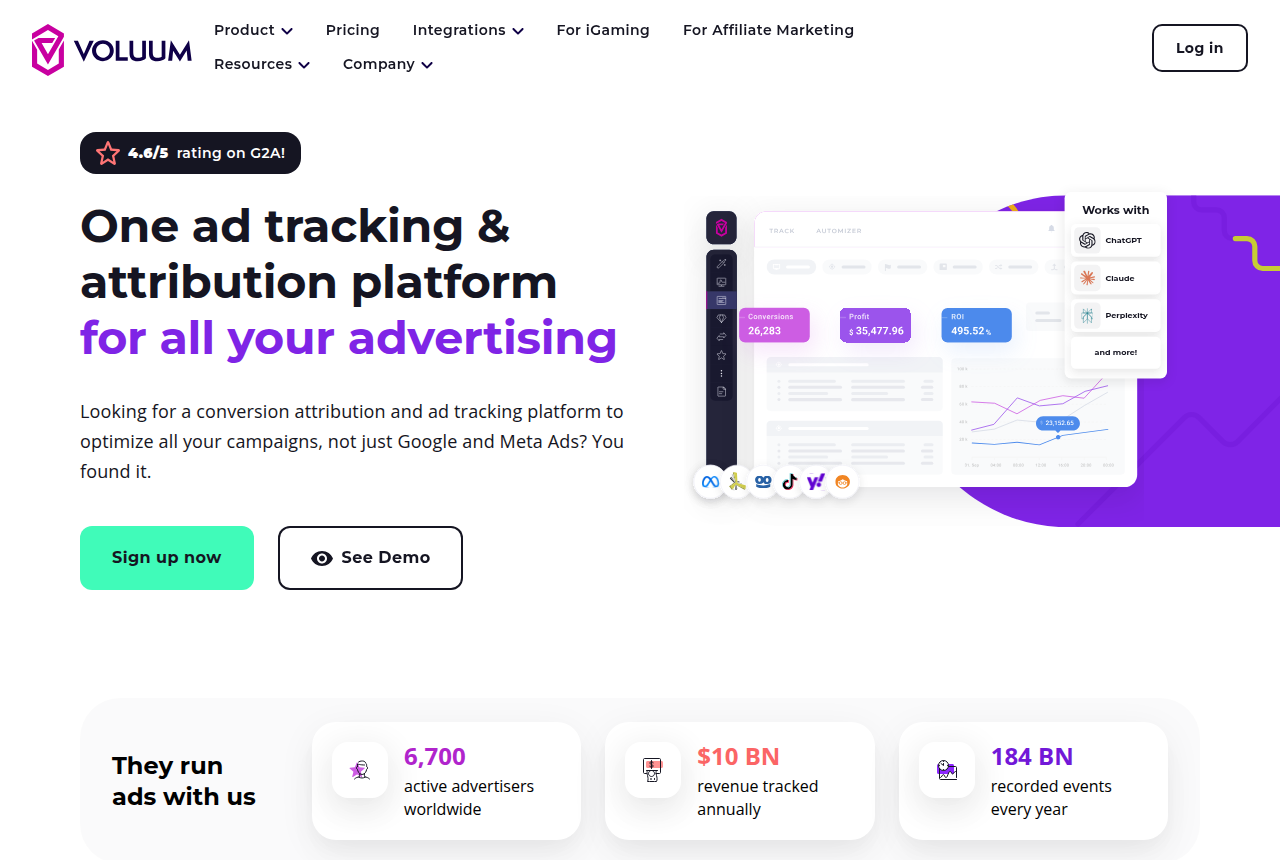
- The homepage offers a 14-day platform preview and says no payment details are required.
What to watch
- Profit includes 20 active campaigns.
- Auto-rules and API integrations are free only up to $1,000 of ad spend a month, then Automizer is a separate subscription.
- Public discussions describe the setup as heavier than a visitor-capped tracker, and say the price pays off once ad spend is high enough to use the allowance.
What you pay when the pool or the campaign count runs out
Paid annually, Solo is $141 a month. The monthly option on that same plan is $169. Profit is $119 a month billed annually. Affiliate plans at RedTrack start with a 14-day free trial. Profit is the lower annual price. Choosing it only because the number is smaller gets expensive once you need Scale so more campaigns can stay running, or once spend passes the free Automizer allowance and that import becomes its own subscription. Solo's higher annual price includes Conversion API and ad-level cost updates, with no spend limit stated on the card. The RedTrack Solo pricing breakdown puts the annual rate next to the monthly one. The Voluum Profit limits page puts the event quota next to the campaign cap.
Events past Solo's allowance are still tracked, and additional events are billed at $0.04 per 1,000. Profit charges $0.06 per 1,000 events past the quota, at the end of the billing cycle. The next RedTrack step on an annual bill is Team, at $333 a month, with 20 million events and five users. Solo includes one login, so a second user has to move to Team.
Voluum's next annual plan is Scale, at $299 a month, with 5,000,000 events and 60 active campaigns. An event on Scale is defined the same way as in the documentation above. Scale lets more campaigns stay active, and it comes with a larger event pool.
Page, checkout, and the sale on one record
RedTrack and Voluum are trackers. They sit beside a lander that already lives somewhere else. ElasticFunnels is a funnel platform for teams that run paid traffic: the page, a same-URL split test, the checkout, and the attribution sit on one data layer, and a network can post the sale back onto that record.
Same-URL split testing is the piece that lines up with an ad account. Variants rotate on the server under one campaign link, so Meta, Google, and TikTok keep optimizing that same link. The platform also builds pages, from a prompt or by cloning a URL, and it hosts the checkout. The page builder and the checkout write into that same record. If the lander and the checkout already live in other tools, RedTrack and Voluum are still the pair to choose between.
Starter is $97 a month, or $937 billed for the year, with 50,000 page views. A page view is one load of a page the platform hosts. The trial lasts 14 days with no credit card required. Pages, funnels, and a custom domain can be set up during the trial.
ElasticFunnels has been around since 2023, so it is newer than the funnel platforms buyers usually compare it with. Independent reviews of its tracking claims are still scarce. Until you run real volume through it, you are largely taking the vendor's word for how the postback and the conversion reporting behave. That is what you would expect from a platform this new. The pages, the checkout, and the split tests are still on the plan while that outside coverage is thin. For the product on its own page, see how ElasticFunnels records the sale. If the other funnel in the set is ClickFunnels, read ElasticFunnels vs ClickFunnels.
Choose Solo for the cap or the sync
Choose RedTrack if you will go past Profit's campaign limit, or if Conversion API and cost updates have to be included on Solo without a separate Automizer bill. Choose Voluum when Traffic Distribution AI is what you came for and your campaigns, landers, and event mix still fit Profit.
Our pick
RedTrack
RedTrack is the one to choose if you want the Meta and Google conversion API, and ad spend sync, on the first affiliate plan.
Questions
Do both entry plans include a conversion API?
What counts as an event on each plan?
What happens past twenty live campaigns on Profit?
When does Voluum charge for Automizer?
Can I stay on Solo with one ad account?
What we read
From RedTrack
Voluum pages
From Voluum
Where to read the plan in full
- Facebook pixel vs Conversions API, and which machine sends the Meta event.
- RedTrack review for Solo on its own page.
- Voluum review for Profit on its own page.
- RedTrack Solo pricing breakdown for the annual rate and the monthly option.
- Voluum Profit limits for the quota and the campaign cap.
- RedTrack vs ClickMagick on the first invoice if that tracker is still in the set.
- ClickMagick vs Voluum on visitors against events if the visitor meter is the other option.
- RedTrack alternatives if one login is the limit.
- Voluum alternatives if the campaign cap is why you would leave.
- How ElasticFunnels records the sale when the page and the postback have to share a record.
- All head-to-head comparisons.
- Best affiliate tracking software roundup if you are not down to two.
- How we research these trackers.
See which entry plan fits your traffic
Written by
Nadia Lindqvist
Affiliate tracking
Nadia covers affiliate tracking software for people who buy Meta and Google traffic. She reads vendor pricing pages, documentation and long-term user reports, and she writes about which tracker fits a given buyer.
Last checked 2026-10-17
Comments
No comments yet. Questions and your own experience are welcome.
Thank you. Your comment will appear once it has been reviewed.